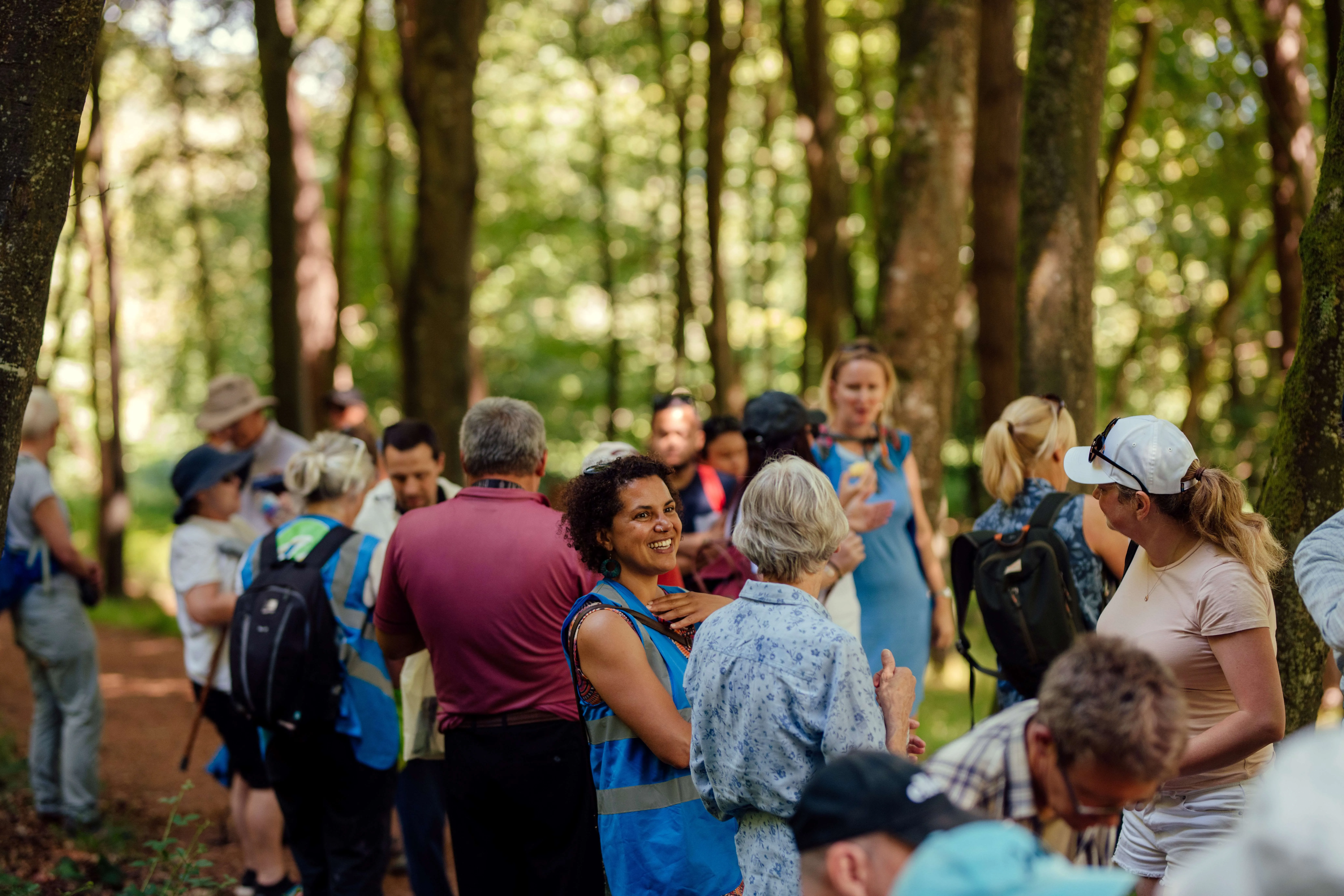
From teenage girls exploring the Northumberland Coast, to wildlife finding shelter inside a bench on the Thames Estuary, the National Trails UK (NTUK)’s new Test and Trial Fund, is backing small-scale, local projects with the potential to unlock big benefits for people, nature and climate along Britain’s iconic walking routes.
In this blog we shine a spotlight on five of the ten projects chosen. Each one is testing a practical approach to improving access and inclusion, restoring nature, building climate resilience and supporting local economies along the UK’s National Trails. Each is a story of community, creativity and hope. Together they offer valuable lessons for both National Trail teams and funders looking to scale what works.
Wilder Coast Collective: Engaging communities along the Lincolnshire Coast
Along the Lincolnshire coast, volunteering opportunities exist, but too few local people feel able, welcome or motivated to take part. Without strong community involvement, ambitions to restore nature and improve wellbeing along the coast risk falling short.
“So far we’ve found that an ageing population, many of whom are incomers, are deeply connected to the coast but don’t know how to help. The general feeling from the local population is that environmental improvements must have an economic benefit.” David Rodger, National Trail Officer, King Charles III England Coast Path – Lincolnshire section
These challenges sit at the heart of two interlinked projects supported along the Lincolnshire section of the King Charles III England Coast Path (KCIIIECP) National Trail and its coastal margin. Together they test new ways of listening to communities and building a stronger sense of local ownership of the coast.
Both are led by the Wilder Coast Collective (WCC), a partnership of 18 organisations, united by a shared vision to increase biodiversity and enhance community wellbeing along the Lincolnshire Coast. Partner organisations include the Lincolnshire section of the KCIIIECP, represented by Lincolnshire County Council, Every-One Lincolnshire, Butterfly Conservation Lincolnshire, National Trust, Lincolnshire Outdoor Learning Centre, Lincs Community and Voluntary Services and Natural England, to name just a few.
Deep Listening Lincolnshire: Informing inclusive, community led coastal projects
The success of the Wilder Coast Collective’s projects depends on active volunteer involvement, yet uptake of volunteering opportunities along the Lincolnshire coast is low. Without local people stepping forward, ambitions to enhance biodiversity and community wellbeing can’t be realised.

‘Deep Listening Lincolnshire’ is responding by placing listening before action. Through eight engagement sessions across the Maplethorpe area, the project seeks to better understand the social and environmental challenges facing coastal communities. The insights gathered will inform best practice recommendations for inclusive project design and delivery, placing community ownership and stewardship at the heart of all future environmental projects.
Create a character: Creative engagement for coastal nature and community stewardship
To build a lasting connection, you need to engage people emotionally and research shows we remember stories 20 times more than facts. The ‘Create a Character’ project uses storytelling and creativity to help communities develop a stronger sense of belonging to the Lincolnshire coastline.
Through a community led workshop facilitated by local artists ImageSkool, residents co-create a mascot or folklore character inspired by Viper’s Bugloss - a native coastal plant. This character will act as an innovative engagement mechanism to spark conversations about coastal nature, change and caring for the environment, while helping the local community feel a stronger sense of connection and ownership.
So far the Wilder Coast Collective has engaged with 13 community leaders for the Deep Listening Project, had over 100 survey responses and a further 200 + people actively engaging with WCC and we are looking forward to hearing progress between now and end of March.
Empower Her Wild: Building confidence, skills and sense of belonging for girls on the Northumberland Coast

For many teenage girls the outdoors can feel intimidating or inaccessible. Statistically, girls are more likely than boys to perceive greater risk when spending time outside and to experience mental health challenges. The project aims to support teenage girls to feel safe, confident and welcome at the coast and along National Trails.
‘Empower Her Wild’ has been developed by Northumberland Coast National Landscape and outdoor education specialists Mudlarks Outdoors Ltd to address these barriers along the Northumberland Coast section of the King Charles III England Coast Path National Trail. The project seeks to create a nurturing, all-girl environment where participants can build confidence, skills and a sense of belonging in coastal landscapes.
"We’re really excited to have developed this three-day programme for girls living locally to the coast, but who’ve not experienced what makes it so special, and for them to meet some of the empowering women who are caring for it. Going forward, this pilot is key to develop our understanding of engaging this group of young people, potentially via the amazing work of our Conservation Team volunteers.” Iain Robson, Northumberland Coast National Landscape Manager

Funding will support three immersive day sessions for girls aged 16–18, developing skills in map reading and navigation, camping, and sparking an interest in the landscape and its natural and cultural heritage. The girls will be encouraged to keep a nature journal and will complete hands on conservation activities during the programme.
They will meet and be guided by women working in conservation and landscape management from local partner organisations Space for Shorebirds, Natural England, National Trust and Northumberland National Park Authority.
Entitled ‘Discover, Connect and Create - A day to get to know other participants and the Northumberland Coast', the first session will involve the ultimate ice breaker of coasteering at Beadnell followed by a guided nature walk along the Coast Path with rangers from Space for Shorebirds.
The second session focusses on empowerment, skills and confidence and comprises a day’s camping at Football Hole, a hidden gem of a beach cared for by the National Trust at Newton by the Sea.
The final session includes a visit to the Bamburgh Bones at St Aidan’s Bamburgh and the opportunity to experience part of the Pilgrims Way across the sands to the Holy Island of Lindisfarne.
Biodiversity benches in the Medway: Green infrastructure for people and wildlife
On the Medway coast, a bench is doing far more than offering a place to sit. Along the Medway section of the King Charles III England Coast Path and coastal margin, the Medway Swale Estuary Partnership and Medway Council are working with the Kent Coast Holiday Park to install three innovative ‘biodiversity benches’.
Designed using metal gabion cages filled with a mixture of organic (wood) and inorganic (flint, concrete and brick) materials, the benches will provide habitat and shelter for invertebrates and reptiles, while a raised bed planter, will provide space for native wildflowers to benefit pollinators.
With supporting interpretation, the benches will invite trail users and holiday makers to pause, take in views across the Thames Estuary and learn about the benefits of green infrastructure. The project also links into a circular walk developed by Medway Council’s Heritage Lottery funded Whose Hoo project.
Relatively low cost and easily replicated, the approach offers a practical model for enhancing biodiversity along other sections of National Trails, especially in urban areas. It also showcases the value of working with local landowners keen to engage with the trail and support nature recovery.
“We're really pleased to be working alongside the team at Haven's Kent Coast Holiday Park, as part of our long-term aim to increase biodiversity along the King Charles III England Coast Path in Medway. Especially given the opportunity the park's popularity will also provide, showcasing to visitors the potential benefits of such an approach to providing wildlife habitat in their own outdoor spaces.” Mark Loos, Partnership Manager for the Medway Swale Estuary Partnership
Peatland restoration along the Pennine Way
Wildfire damage in 2021 left areas of blanket bog along the Pennine Way at Marsden Moor degraded and vulnerable. Blanket bogs are a rare and globally important habitat. But while restoring them is essential for climate resilience, biodiversity and long term health of upland ecosystems, this work often happens out of sight.
At the National Trust’s Marsden Moor estate in the Peak District National Park, funding is supporting the restoration of moorland adjacent to the Pennine Way National Trail, turning a typically hidden process into a visible story of nature recovery.
The project includes installing sheep’s wool logs which are fire resistant compared to coir logs, which were previously used. Cutting back of 1-2 hectares of purple moor grass which has colonised and degraded the blanket bog and re-planting common cotton grass and sphagnum moss species with volunteers. New interpretation at the entrance to the site will help connect trail users with the restoration taking place.
Alongside ecological benefits for peatland restoration that will in turn support wading birds, the project weaves in wider messaging around sustainability. The plants are sourced from the National Trust's own nursery in Marsden. The wool is held in felt bags made from 100% recovered materials developed in collaboration with the University of Huddersfield’s textiles department.
“The National Trust has an ambitious plan to restore nature across our land. ‘Stitching the Landscape’ tells a new story about how we can use sustainable methods, local materials and innovative techniques to meet this ambition. This project will not only improve the resilience of our blanket bog, especially from wildfire, but by engaging with people that walk the Pennine Way, it will also reach new audiences and have a lasting impact on the trail”. Ian Dowson, National Trust’s Area Ranger for Marsden Moor
Summary and look ahead
These five projects already show how a modest fund with as little as a few thousand pounds can spark real, ground-level action for nature, access and community benefit. Together, they illustrate what’s possible when local people, land-owners and National Trail partners collaborate with flexibility, creativity and a shared vision. As we watch them unfold over the coming months, we hope their successes (and even their challenges) will shape a template that can be applied across many more stretches of our National Trails.
In a couple of months’ time, we’ll come back with the next instalment in this series - a blog diving into the remaining five projects chosen by the Test and Trial Fund. Expect deeper insights, practical learnings and shared reflections on how these Test and Trial projects can strengthen nature recovery, improve access and inclusion, build climate resilience and support local economies, helping both National Trails teams and funders understand what works on the ground, so successful approaches can be scaled up with confidence.
The Test and Trail fund launched in June 2025, thanks to funding from Defra via the Protected Landscapes Partnership.
If you missed the first blog in the series you can find it here.
Main image: copyright Gavin Duthie, Northumberland Coast National Landscape
More posts
_Abbie%20Merritt_lpr.jpg)
NTUK Procurement - Paths to Inclusion Evaluation Consultant

The people behind the path: How volunteers keep the Cotswold Way National Trail thriving
How National Trails helped me understand my AuDHD
Signup to our newsletter